

Within the past couple of years, the cannabis industry has undergone a seismic shift. What once stood as a nascent underground culture has evolved into a highly-visible, multi billion-dollar global market. As legalization sweeps across the country and around the world, the demand for cannabis products continues to surge, augmenting the era of unprecedented growth and innovation. In this rapidly changing landscape, a new generation of visionaries and entrepreneurs are emerging to redesign the industry. And this reinvention is not limited to the sphere of consumerism. Rather, these figures are leading the tireless effort to cultivate a responsible, inclusive, sustainable and forward-thinking industry that simultaneously serves the needs of modern consumers and props up marginalized entrepreneurs. Among them is Solonje Burnett.
Erven and Weed Auntie stand as the brain children of Solonje Burnett, who is an advocate, breathwork guide, bridge builder, space holder and creator who hails from Brooklyn, New York. Per her biography, Burnett centers self-care as the catalyst for communal care and infuses her work with intentional efforts to pour into herself. We spoke with Solonje about her work within the rapidly-evolving world that is the cannabis industry, which she entered in 2018.
“Erven and Weed Auntie are the evolution and expansion of my intention to foster communication, facilitate connection, care for and educate the intersectional community,” she explained. “I entered the cannabis industry in 2018 committed to educate and advocate for an equitable, sustainable, and accessible New York market through Humble Bloom, my first foray into this plant based space. It was a time of real cannabis curiosity and with the passage of the hemp bill there was soon an explosion of brands. Danniel Swatosh and I decided to embark on a journey of exploration which turned into one of culture curation, information dissemination, community building, and nonstop learning in an industry in its nascency.”
From there, Solonje would work alongside other powerhouses to spark a number of important changes, all part of the collective effort to heighten the inclusivity of the field. “Together we fought alongside incredibly inspiring individuals and groups to pass the MRTA, connected folks from coast to coast, and made magic happen with no investment creating partner experiences that both supported and platformed marginalized entrepreneurs including people of the global majority, women, and LGBTQ+ – everything from hemp and cannabis farm field trips in New York and California, in-depth conversations on regenerative agriculture, brand launches, and venue programing.” The MRTA refers to the Marijuana Regulation and Taxation Act, the law that legalized adult-use cannabis in New York State.
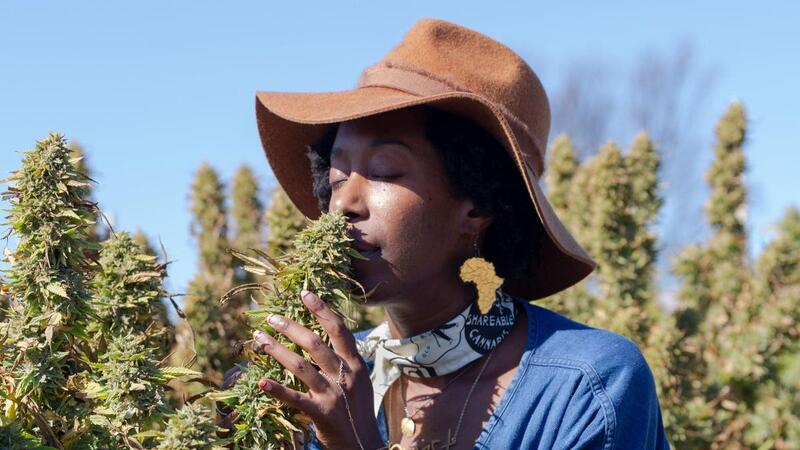
When asked a question regarding stigma surrounding marijuana, namely for populations of color, Burnett answered with a powerful assertion. “Cannabis stigma is colorless. It’s more so the access to capital as entrepreneurs, leadership role opportunities in corporate and mass incarceration due to America’s reliance on prison labor that remain top issues for highly melanated people,” she said. “Nuance matters and simply saying stigma remains for POCs is missing the mark. We need to address the true inequity and injustice that pervade the space. Currently in my work I lead by doing, showing people what it looks like for a Black queer woman to be present, curious, evolve and grow in an ever changing market.”
For Solonje, this takes many forms. “This looks like being a co-founder at the intersection of collaborative B2B technology and cannabis, when most founders focus on plant touching endeavors as retail operators or launching flower brands. It also looks like starting almost every event I curate with a mindful moment, utilizing my tools as a breathwork guide to help folks co-regulate before digesting information and engaging in conversation. It shows up through partnerships with spaces like Soho House and Moxy Hotels to curate cannabis programming, normalizing plant integration socially not only to my audience but to their members and guests. Hosting healing sessions through my Reflection: Intersectional Collective Care series with partner brands helping people work through grief and channel joyful interconnection, support melanated practitioners and their various practices ranging from qigong to sound bowl, acupuncture and massage as well as introducing them to cannabis entrepreneurs.”
Among Solonje’s overarching goals is living with integrity and intention. Currently, this looks like providing social opportunities for people to explore and experience legal products and retail operators.
“I truly believe that we are all interconnected and need each other to flourish. I value and respect plants, people, and the planet we coexist on alongside all other living beings. Acknowledging and learning from each other’s differences while understanding that at a baseline we’re all human. A tie that should unite us as family. My work at Weed Auntie challenges the cannabis and wellness space to move toward holistic intersectional and radical wellbeing, allowing for a full spectrum of individuals to experience healing together with low to no cost in beautiful containers that inspire vulnerability, self awareness and acceptance. All with the goal of collective advancement.”


